

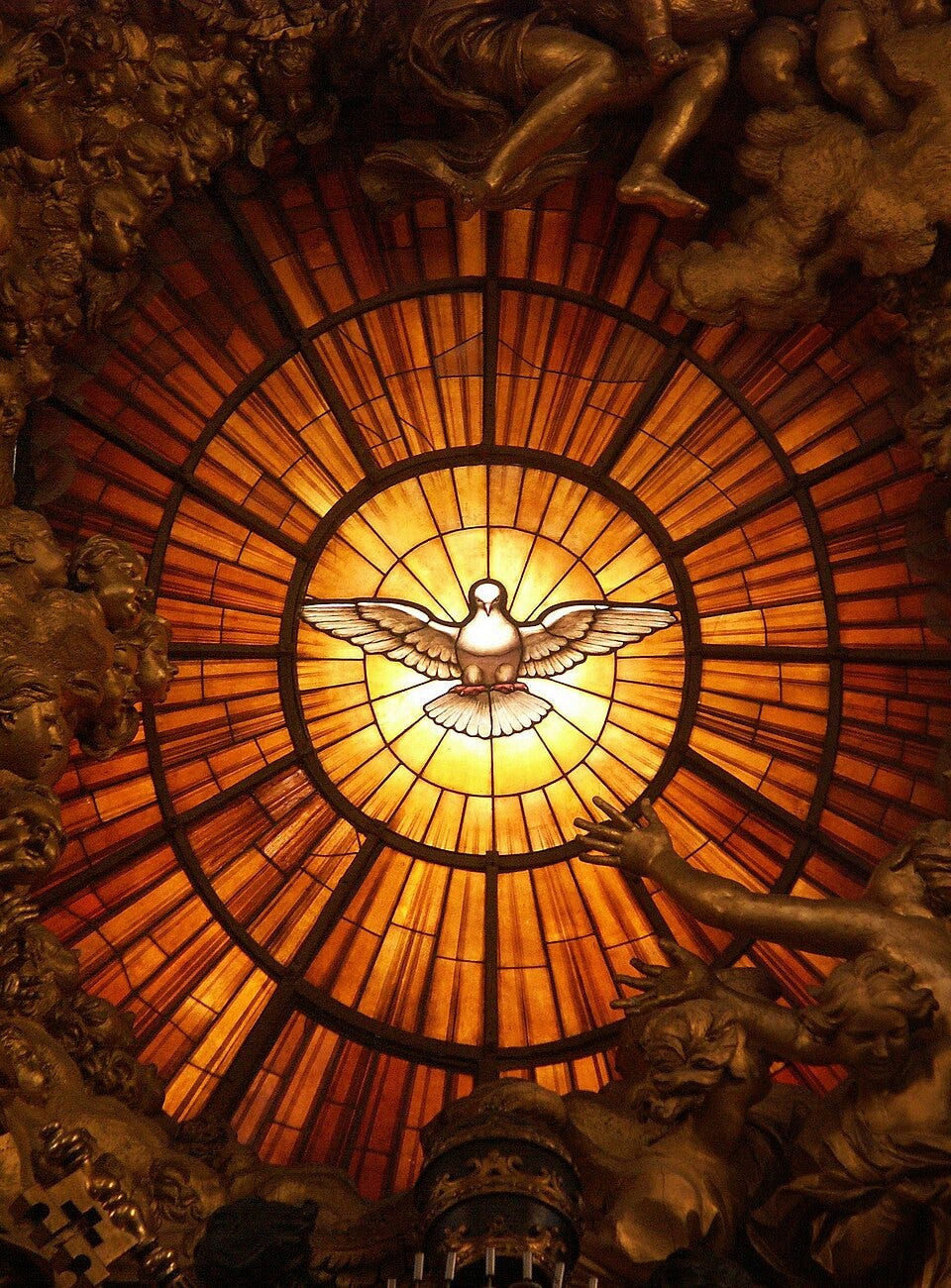
I want to stress that image of active presence. In the Old Testament economy we saw that God would often reveal Himself through the prophets and so forth; and often in theophanies, that is to say there would be appearances of God to the people—to Moses, Joshua, Daniel and others. These manifestations would appear, but in the New Testament, in the Gospel, we got the most decisive revelation of all, insofar as we have God Himself being decisively revealed to us in very clear ways.
So, we see Jesus as the God-man. But, with the coming day of Pentecost, it was the purpose of the Holy Spirit, now, to bring about the active presence of God in the world. I would draw an analogy to creation. Go back to Genesis and look at that imagery. You recall that the Spirit of God was moving over the face of the waters. It was God who spoke it into being, and we know, as well, from John 1, Hebrews 1, and Colossians 1, that Jesus Christ was the One through whom all things were made. So, we have the work of the Father and the Son, but then it is the work of the Holy Spirit who moves upon that work and brings it into activity. What we might say is that it is the Holy Spirit’s work to complete and then to sustain what God the Father has planned and what God the Son has begun. Let me say that again, because I want that to be very clear to you. It is the work of the Holy Spirit in Scripture to complete and to sustain that which the Father plans and that which the Son begins. So, the Father plans, the Son launches, or inaugurates, that plan and the Holy Spirit applies it, completes it, and brings it into being.
I would say that is not only true of the first created order, but also of the new creation. If we consider, for example, the day of Pentecost, with that new creation in Christ, it is the Holy Spirit that came to grant power to the Church. In that regard, in the New Covenant age, He is regarded as the down payment, or the guarantee. In Romans 8:23 He is called the first fruits of our salvation. So, in a very real sense we are anticipating, in this present age, the fullness of the next age, the age to come. So, in a marvelous way we are between these ages; we have one foot in the old, but another foot in the new created order, and even now the kingdom of God can be manifest in us and through us by the power of the Holy Spirit, but not yet in its fullness—it is now but not yet.
I would like us to consider, then, how this works and particularly stress some Old Testament promises that we see regarding the Holy Spirit. There are a variety of texts that told us with increasing clarity He would come, and I would particularly point to Isaiah and Ezekiel in this regard. In Isaiah 32:14-18 it tells us that, “…the palace has been abandoned, the populated city forsaken…until the Spirit is poured upon us from on high…” There is a key phrase there, about the Spirit of God being poured upon them from on high, “and the wilderness becomes a fertile field and the fertile field is considered as a forest. Then justice will dwell in the wilderness and righteousness will abide in the fertile field. And the work of righteousness will be peace, and the service of righteousness, quietness and confidence forever. Then my people will abide in a peaceful habitation, and in secure dwellings and in undisturbed resting places.” It is an image of a day that would come, and this is in a word of consolation to the people. A day would come when God’s Spirit would actually be poured out upon them and rest upon them. In fact, Isaiah 44:3 puts it exactly that way: “I will pour water on the thirsty ground and streams on the dry ground. I will pour out My Spirit on your offspring and my blessing on your descendents.” So, this image of the pouring out of the Holy Spirit is one of the primary symbols; a major symbol of the Holy Spirit is that of water; another is oil; another is fire; and yet another is wind. There are a variety of these images for the Holy Spirit. In yet another text, Isaiah 63:10, we see: “But they rebelled and grieved His Holy Spirit; therefore He turned Himself to become their enemy, He fought against them.” So, we also see that the Holy Spirit relates to the blessing of God. When people turn away from God in disobedience, then He withdraws His Holy Spirit from them.
I also want to look at a key phrase that is found in Ezekiel 36:26-27. We see a very clear picture of what the Holy Spirit would do in the New Covenant order: “Moreover, I will give you a new heart and put a new Spirit within you; and I will remove the heart of stone from your flesh and give you a heart of flesh. I will put my Spirit within you and cause you to walk in My statutes, and you will be careful to observe My ordinances.” So, we see a promise in association with the coming New Covenant, that God’s Spirit would actually be planted within them. This is very similar, by the way, to the imagery you see in Jeremiah 31, where it talks about how God will plant His law and make that law internal and not merely external. So, we see that it is the Holy Spirit, then, that brings this about. You clearly see from this that the Old Testament consistently promises a picture of a great blessing that will come and that it is associated with the ministry of the Holy Spirit. So, as we look at this I would like us to consider a variety of ministries of the Holy Spirit and look at, first of all, how the Holy Spirit empowers His people, and we will tie some of these Old Testament texts together a little bit more as we go along and see how exactly they relate to the New Testament. Ultimately, I am suggesting that it is the Holy Spirit who becomes the manifest agent of God’s presence in this world. We personally can enjoy that presence insofar as we walk in obedience to God and manifest the life that walks by the Spirit and not by the flesh.
The genius of the Christian life is that it is based upon a person. Christianity, as you know, is not a religion but a relationship; it is a relationship with a person and ultimately that personal relationship is mediated through the indwelling Holy Spirit. So, when Jesus said to His disciples that “I go away, and it is necessary for Me to go the Father so that I can send another Comforter. He will not only be with you; He will be in you.” If you turn with me to John 7:37 you see a wonderful image of how the Holy Spirit would fulfill all these images of the Old Testament on the last day, the great day of the feast: “…Jesus stood and cried out, saying, ‘If anyone is thirsty, let him come to me and drink’.” Again, we see that image of water; remember that image of living water that Jesus offered. He goes on to say, “He who believes in Me, as the Scripture said, ‘From His innermost being will flow rivers of living water’.” What a remarkable image that is. It is not merely that you are pulling up from the well bucket by bucket; you are actually tapping into an artesian source, like a spring or an indwelling river, of living water; and this water comes from within and it has no boundaries. Once you have received of the Spirit, then you have this water. Verse 39 says: “But this He spoke of the Spirit, whom those who believed in Him were to receive; for the Spirit was not yet given, because Jesus was not yet glorified.” This tells us that there is a radically new relationship people have with the Holy Spirit.
In the Old Testament economy, the indwelling of the Holy Spirit appeared to be selective and sometimes temporary. That power to bless could be withdrawn; but in the New Covenant, especially since the day of Pentecost, the Holy Spirit makes His indwelling in us and we become temples of the Holy Spirit. So, He has a permanent residence in us and it is universal in all the members of the body of believers. There is a radically new dimension to the Holy Spirit in our lives.