

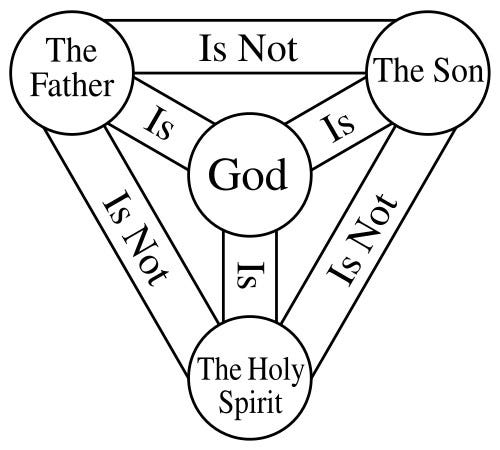
We are going to be looking tonight at the most profound mystery of all, and in doing so we are going to be coming down to the very heart of all things. When we think talked about the attributes of God that we have been looking at, we about two kinds of attributes. We talked about those which are often called incommunicable, which means they are unique to God and completely transcend our experience. Those kinds of attributes include that God is utterly independent, unlike ourselves; we depend on air and food and our lives are completely contingent on that. God requires nothing and depends on nothing.
We saw, as well, that God is unchanging; whereas we change, He never changes in His character or in His purposes. He is also eternal; He is boundless and outside the realm of time and space, which is part of His created order, and that we, on the other hand, are always going to have some connective experience of time, even in the resurrection, although our experience of time there will be different. Nevertheless, we are inexorably connected to time and space, whereas God transcends them. We saw, too, that God is omnipresent and that He is at all places at once. Again, we have no category for that. We also discussed God’s unity, or simplicity, which means that He has no parts and is a unified being and all His attributes are exhaustive of Himself.
Then we looked at some of the communicable characteristics of God; those things that we share as created beings in the image of God and that show and stress God’s personal nature. We are reminded of the incommunicable attributes, that God is infinite and personal. However, we, because we are personal beings, have been created with a spiritual nature that is our deepest self and with a capacity to commune with God. Whereas our soul is our capacity to know ourselves and to know others and our body is our capacity to relate to, and respond to, our environment. We are beings, who have not only a body and a soul, but we also have that image of God, that spirit; and we are moral and we are moral agents as well. Unlike animals, we are aware of things they are not; our immortality for example, and we have a longing for a spirituality that cannot be sustained by anything in this present life. That is why we discover that nothing on earth, no significant achievement, no relationship, no position or possession, can ever fully satisfy our human desires and aspirations.
What we discover in Scripture is that it is God that we long for, and only He can provide the fundamental sustaining of our lives. When we talk about this God we have at least have certain things that we can relate to more directly; things like spirituality—that we are spiritual beings; and that God is invisible, but there is something about us that is also unseen, that we are in this earth suit, but there is something about us that transcends that earth suit as well. God has the attributes of knowledge and wisdom and truthfulness, and we can share those attributes, at least in part.
God has the moral attributes, as well, of goodness and mercy and holiness and peace; and we can share in those attributes as well, at least to some degree. As we allow the Spirit of God to be manifest in us, we become more like Him, conformed to His image. God also has the attribute of purpose, where He has a clear will and a purpose for His creating things, and we, too, are called to a purpose. Although it amazes me, parenthetically, that many people have purpose statements for their business but they have no life purpose statement. They have an idea of what they want their business to be, but not their lives. God calls us to a meaningful and purposeful existence and it is never too late for us to hammer that out.
Furthermore, we saw there were attributes like perfection and blessedness and beauty and glory. In some mysterious way we all are called to become more and more like Him; and one of the most important ways we are to become like Him is for us to be beings in community and in a communion with other people; first with God and then with one another. It is our relationship with God that actually empowers us to become people who are more than individuals.