

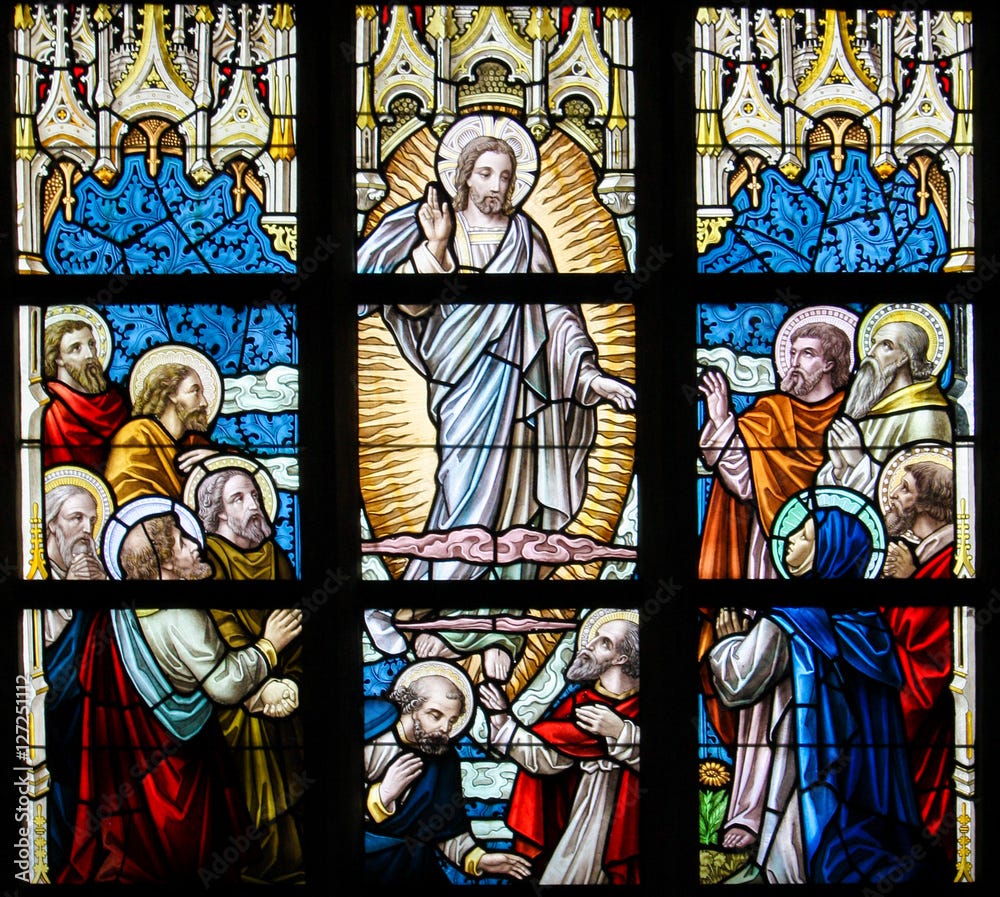
In the last article, we looked at the resurrection of Christ and the implications of His resurrection for our own resurrection. I stressed that the nature of His resurrection was not merely some spiritual event; it actually involved a bodily transformation; a transformation into a body of glorified flesh in which there was continuity but also certain noticeable differences. The fact that He could appear in the disciples’ midst; the fact that He could disappear from their view; and the fact that he could appear in a different form in such a way that they could not recognize Him, but was recognizable in the breaking of the bread—all these circumstances indicate there was some continuity that we can recognize. I believe that will also be parallel to our future as well. We will look different, but you will recognize people that you knew here. In a certain way we will be ageless; neither young nor old, but perhaps have all ages in one.
We are invited to see in Scripture that the nature of Christ’s resurrected body is really an exemplar of our own resurrection body. We know this from texts like Philippians 3, which tells us that God, through His power, is going to transform the body of our humble beings into conformity to the body of the resurrected Christ.
1 John 3 says, also, that we will be like Him. We will see Him, we will be like Him, and we will see Him just as He is. This resurrection body is localized in some aspect; and there is some sense that this body is in one place at one time, but Christ, in His divine nature, is at all places and, in fact, is inside of us. We see, “Wherever you will be, I will be also,” and “Wherever two or three are gathered in My name, there I will be also.” All those promises indicate this to be true. Both the Father and the Son participated in the resurrection and the nature of the resurrection ensures that we will be—body, soul, and spirit—made like Christ.
That is the promise we have, and it gives us real ethical significance and a sense of purpose. First of all, our obedience is not in vain; and our toil is not in vain.
We are not looking at our resurrection here; we are focusing on Christ’s resurrected body. I would say, however, by way of application, that 1 Corinthians 15 demonstrates that if Christ is not raised then we are not going to be raised. The whole idea of Christ being raised from the dead is the basis for our resurrection is meticulously developed in that whole long chapter, which covers fifty-eight verses. Significantly, near the end, when Paul says, “I will tell you a mystery, we will not all sleep, but we will all be changed in a moment, in a twinkling of an eye…,” he is saying that those who are alive when Christ returns will be transformed instantaneously into a glorified resurrection body. Just as the body was sown as a perishable body, it will be raised as an imperishable one; it was sown in dishonor and it will be raised in glory. The text stresses the idea that our bodies now are perishable, but the “…mortal must put on immortality.”
In sum, there are many contrasts to what we are now in and what we will enjoy. I will stress enjoy, because it will be a body we will truly enjoy. It won’t wear out, age, or get tired; and it will be forever young and vital. Our cognitive capacity will also be much greater. Not only will you not need to sleep or get tired, but this cognitive ability will be extended—along with our physical and emotional capacities.
Frankly, we cannot grasp it all in this life, which is why we see the text say, “The eye has not seen, neither the ear heard, nor has entered into the heart of man things that God has promised to those who love Him.” In light of this, Paul’s application about the fact that we will be resurrected, those who are in Christ, we see, “Therefore, my brethren, be steadfast, immovable, always abounding in the work of the Lord”—and here is what I want to emphasize—“knowing that your toil is not in vain in the Lord.” Whatever we do for Christ’s sake is not going to be wasted; it will be recorded and it will not be in vain. We see clear encouragement for obedience, and I would also say encouragement for heavenly reward and the pursuit of that reward that God has in store for us.
The point is that “When Christ, who is our life, appears,” as Colossians 1:3 says, “…we also will appear with Him in glory.” So, it would be prudent for us to pursue the things that are rewards; and rewards are always based on faithfulness to opportunity. Rewards in the kingdom of heaven are based on our faithfulness to the opportunities we have received now. It is not based upon how big a splash you made on the earth, but on what you did with what you were given. People are given different measures of time, talent, treasure, and abilities, as well as different spheres of relationships.
I want to stress as well that this is who we are; already we have a spirit who has been made perfect. In your deepest you, your spirit is already righteous in God’s sight because Christ is in you. In your deep, inner being, you already have that of the new creation, which is designed to spill over from the inside out, from the Spirit into your soul, which is your mind, your will, and your emotions. It is a Spirit-soul-body process. Ultimately, God will perfect and complete that which is imperfect now. We well know that we will need the purification that will be necessary when we stand before Him; and He will purge us and purify us of all that is not of Christ in us so that we then can be made complete and perfect.
This is a context of encouragement, then, and an exhortation to live well and finish well, because nothing that you suffer and nothing that you do for His sake will have been in vain.