

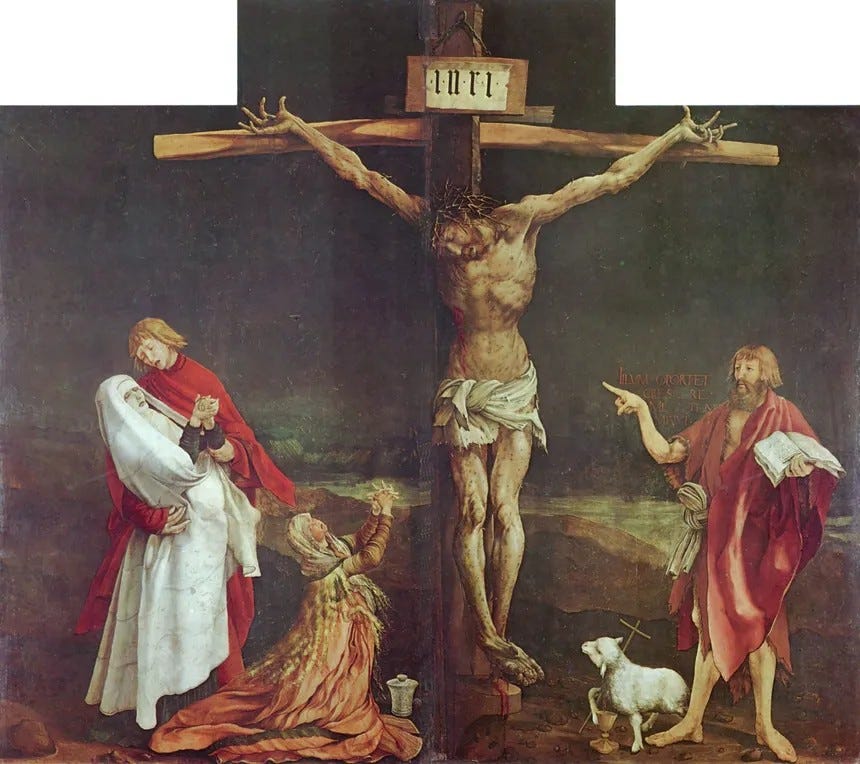
We are going to be looking in this article at the Atonement, and what is meant by the Atonement is the work that Christ did in His life and death to earn our salvation. We cannot earn salvation; Christ earns it for us. Effort is not opposed to grace, but earning is. So, we can be involved in diligence and effort, but the issue of earning is entirely another matter. Only Christ, the God-man, can earn righteousness before a righteous and perfect God. This is especially so when you consider the fact that the standard is our thoughts, our words, and our deeds. It is not merely your actions; it is also your heart. As we well know, there was only One who was perfect in thought, word, and deed.
Now, the mystery of the Atonement relates to the mystery of the God-man. In the last article we talked about the hypostatic union and the idea that in His being there were two natures in one person. In Calcidon in 451 we saw that this concept became the unified teaching of the Church, after a quite a good deal of debate.
To understand how the Atonement was possible we must understand that we have mysteries both in the Trinity and in the God-man. Both of these mysteries intersect in one way or another. I can point to the fact that Christ’s person, as a whole, consists of a human nature and a divine nature, but in one person. At the same time, there never was a time when the Son was not, but there was a time when the human person was not. In other words, Jesus came into being 2,000 years ago, but the Son of God never came into being.
Now, Jesus was merely the name of the incarnate God-man, but the person of the Son of God always exists; there was never a time when the Son was not. The Father, the Son, and the Holy Spirit, though one God, are not each other; but each of them constitutes the fullness of the Deity because in Christ the fullness of the Deity dwells in bodily form.
In understanding the nature of why Christ came, you recall that He gave certain purpose statements. One of those statements was to serve and give His life as a ransom for the many. ‘Ransom’ is a very significant word; it indicates to pay a price or to purchase us and to purchase our salvation. You will also recall that elsewhere He said, “The Son of Man has come to seek and to save that which is lost.” So, His intention in coming, then, was in fact to seek us out; it was not that we sought God, but that he sought us and pursued us. God is the lover of your soul and He is the One who pursues you. A third purpose statement was when Jesus said in John chapter seventeen, “Father, I have completed the work that You have sent Me to do.” Now, that work was boundless in a way, and yet locked into time as well. Putting those things together we get a coherent picture of His work.
There are other dimensions of Christ’s work, namely His resurrection and ascension. All these relate to our atonement, but I am going to focus on the life and the death of Christ. I want to stress that this issue is particularly well-communicated and outlined in the book of Romans. The first half of Romans homes in on the issue and the mystery of the problem of human condemnation and God’s solution to that problem by providing righteousness; and then the nature of walking in that righteousness; and then what it means to be a people who are being prepared for glory.
Paul, having proven his case that both Jew and Gentile all fall short of the glory of God, focuses in chapter three on the summary. In this vision, particularly verses twenty-one to thirty-one, we see one of the richest texts in all of Scripture; and it summarizes the work of Christ. He uses a variety of terms. It speaks about the righteousness of God; it speaks about the idea of what it means to be sinful and fall short of the glory of God; and being justified, as a gift, by His grace through redemption, which is in Christ Jesus. The word propitiation is a term that speaks of the wrath of God. Paul speaks of how the wrath of God is now upon those who do not know Him. Propitiation means a satisfaction that appeases God’s wrath; and in so doing it changes God’s wrath toward us into favor. So, God is now propitiated and He will never now show wrath to a believer in Jesus Christ. We see, therefore, in Romans 8:1 that “There is no condemnation for those who are in Christ Jesus.” Thus, a person who is in Christ Jesus never need fear the wrath of an angry God because that sin has now been decisively dealt with by the righteousness of Christ.
Now, think about this one-line question: how can God be just and justify sinners? The one-line answer is: the righteousness that God requires is that righteousness which His righteousness requires Him to require. This means that God cannot judge on a curve. Therefore, His righteousness requires Him to require perfection. The Biblical vision of God is one of an Almighty but also of a personal being. As a personal being He is the ultimate quintessence of morality. He is of perfect character, beauty, and truth—the true, the beautiful, and the good. All these traits find their absolute in the unchanging and uncompromising character of the living God. This portrait of His character is developed through the Torah and through the prophets, and most clearly communicated in the incarnation of the One who is, and became for us, wisdom and righteousness and sanctification and redemption.