

The last few articles reflected on the purpose and structure of the Sermon on the Mount. Now, we’re ready to begin exploring the sermon itself, starting with the Beatitudes—those opening words that set the tone for everything that follows. Before we dive into the details, reviewing them will help center our hearts and minds:
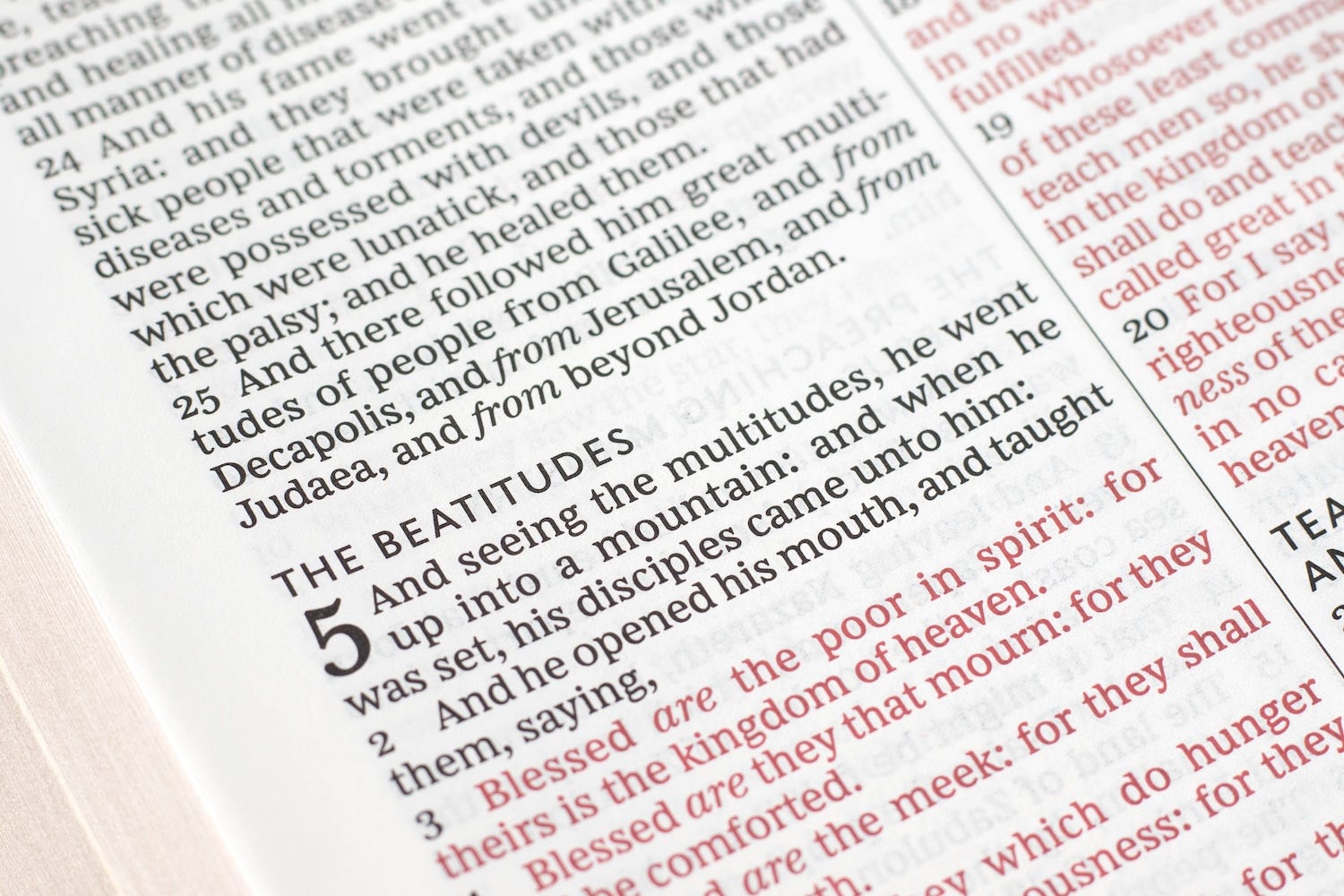
When Jesus saw the crowds, He went up on the mountain; and after He sat down, His disciples came to Him. He opened His mouth and began to teach them, saying:
“Blessed are the poor in spirit, for theirs is the kingdom of heaven.
Blessed are those who mourn, for they shall be comforted.
Blessed are the gentle, for they shall inherit the earth.
Blessed are those who hunger and thirst for righteousness, for they shall be satisfied.
Blessed are the merciful, for they shall receive mercy.
Blessed are the pure in heart, for they shall see God.
Blessed are the peacemakers, for they shall be called sons of God.
Blessed are those who have been persecuted for the sake of righteousness, for theirs is the kingdom of heaven.
Blessed are you when people insult you and persecute you, and falsely say all kinds of evil against you because of Me. Rejoice and be glad, for your reward in heaven is great; for in the same way they persecuted the prophets who were before you.” (Matthew 5:1–12)
These verses are brief, but their meaning is rich and deep. They reflect one of the trademarks of Jesus’ teaching—simplicity joined with profound insight. The more you meditate on them, the more they open up. The wisdom Jesus offers here is never exhausted; new insights emerge every time you return to them.
Let’s begin by asking: Who are these “blessed” people Jesus describes? What kind of person is He calling “blessed”? The Beatitudes present eight qualities, and they are not describing eight different kinds of people. Rather, they are a portrait of the character traits that should be true of every follower of Christ. These are not random or optional traits, given to some and not to others. Like the fruit of the Spirit in Galatians 5, they describe the complete character of a Spirit-filled life. The person who is meek is also pure in heart. The one who mourns also hungers for righteousness. These are not separate callings—they form a unified vision of godly character.
Now, none of these qualities come naturally. They are not achieved through sheer effort. They are the result of God’s grace at work in us. You cannot fulfill the Sermon on the Mount in your own strength. It is impossible without the power of the Holy Spirit. Yet, we are still called to long for these qualities—to desire them, to pray for them, and to grow into them.
It's important to see that these qualities are spiritual, not material. Jesus says, “Blessed are the poor in spirit”—not simply the materially poor. Similarly, those who “hunger and thirst for righteousness” are not simply hungry for food. Luke’s account shortens some of these phrases, but Matthew makes it clear: these are spiritual conditions, not social or physical ones. Jesus was not indifferent to poverty or hunger, but His Kingdom is not built on external conditions. His Kingdom is spiritual in nature and eternal in purpose.
Jesus demonstrated the power of this Kingdom through miracles—healing the sick, casting out demons, feeding multitudes, even raising the dead. These were signs that the Kingdom of God had come near. But the deeper reality was not in the miracles—it was in the transformation of the heart. That’s what He invites us into.
Now, let’s look at that first phrase—“poor in spirit.” It’s essential to understanding all the Beatitudes. What does it mean to be “poor in spirit”? It speaks of humility—recognizing our spiritual bankruptcy before God. It’s the opposite of pride. It means coming to God empty-handed, knowing we have nothing to offer and everything to receive. Without this first Beatitude, the rest make little sense.
Jesus begins with “Blessed are the poor in spirit,” because this is where the journey of faith begins. It is only when we know our need that we can receive His grace.
Let’s also consider the word “blessed.” The Greek word used here, makarios, is sometimes translated “happy.” But that translation can be misleading. While obedience to God’s commands often leads to joy and peace, happiness is a fleeting emotion. “Blessed,” in the biblical sense, means something much deeper. It refers to God’s approval—His favor, His affirmation. It’s not about how we feel. It’s about how God sees us when we live according to His ways.
There’s a tendency today to reduce biblical truth to personal experience—to say, “This makes me feel good,” rather than “This is true.” Even in worship, we’ve shifted the focus from who God is to how we feel. Many older hymns focused on the character and glory of God—His power, His holiness, His redemptive love. But now much of modern worship centers on our emotional experience. That shift, while understandable, can be dangerous. It turns our faith inward and makes it more about ourselves than about God.
That’s why I prefer the word “blessed” over “happy.” This is not about personal satisfaction—it’s about living in alignment with God’s will and receiving His favor.
Let me also make a distinction between happiness and holiness. Happiness is subjective; it’s based on circumstances and feelings. Holiness is objective; it reflects God’s character. And while holiness often leads to a deeper joy, God is more concerned with our holiness than our happiness.
Holiness means being set apart. It is a word that reflects a life devoted to God. It is not simply avoiding sin, but actively pursuing God’s purposes. Holiness is not just about being good—it’s about being transformed. It is being set apart from the world and its values and being set apart unto Christ. It involves a new identity and a new authority. Holiness leads to a life that is marked by virtue, integrity, and spiritual beauty.
Unfortunately, even the idea of character has been weakened in our time. We’ve replaced it with personality. But personality is surface-level—how we appear to others. Character goes much deeper—it is who we are when no one is watching. Holiness shapes character, and character shapes a life that honors God.
As we reflect on the Beatitudes, we are invited to a different way of living. This is not a self-help manual. It is a call to die to ourselves and live by the Spirit. Each Beatitude challenges the world’s values and affirms God’s. The poor in spirit are blessed, not the self-reliant. Those who mourn are comforted, not those who avoid sorrow. The meek inherit the earth, not the assertive or aggressive. Those who long for righteousness will be filled—not those who are content with mediocrity.
These teachings turn the world upside down. But they are not unrealistic. They are attainable—but only for those who have been born again, who have received the Spirit, and who are daily learning to walk in step with God.
So as we begin to explore each Beatitude in more depth, let us do so with humility and with hope. These are not rules to perform, but gifts to receive and cultivate. They are the marks of a life shaped by grace.
We need to recognize that the Sermon on the Mount was spoken to people who had already received forgiveness—those who were poor in spirit, who had mourned, and who had found grace. These are the ones who discovered the “pearl of great price,” who found treasure in a hidden field, who were invited to the wedding banquet of the King (Matthew 13:46; 22:1–14). These are new creations in Christ. As Paul writes, “If anyone is in Christ, he is a new creature; the old things passed away; behold, new things have come” (2 Corinthians 5:17).
Now, we don’t always feel like new creations. But that’s not the point. We are called to live into that identity by faith. Spiritual growth is rarely linear. It is often slow, sometimes messy, but always moving forward under the guidance of God’s Spirit.
At the heart of this is a longing—a deep desire for satisfaction, purpose, and identity. God knows this. He designed us with those longings. They are part of what it means to be made in His image. But the world offers shallow substitutes. The world tells us to pursue money, pleasure, and power—external things that promise happiness but cannot satisfy the soul.
What do people think they want? Wealth, success, recognition, comfort. But what do we truly need? A restored relationship with God. A life of meaning. A soul that is whole. True satisfaction doesn’t come from fulfilling superficial desires. It comes from aligning our lives with what is eternal. Great literature and film often illustrate this journey. A character begins with shallow desires—money, fame, or control—but through pain and struggle, he discovers his real needs: love, truth, forgiveness, and transformation.
This is what the Christian life is about. As we grow in Christ, we move from felt needs to real needs. Our desires deepen. And so does our character. Surface living may be common, but it leaves us dry. But when our roots go deep into the soil of God’s Word—when we draw nourishment from the living water of His truth—our lives take on a richness, a depth, a quiet strength.
That’s the picture in Psalm 1:
“How blessed is the man who does not walk in the counsel of the wicked,
Nor stand in the path of sinners,
Nor sit in the seat of scoffers!
But his delight is in the law of the Lord,
And in His law he meditates day and night.” (Psalm 1:1–2)
Did you notice the pattern? First we walk, then we stand, and finally we sit. It’s a slow but steady descent into compromise. But the one who delights in God’s Word—who meditates on it day and night—is like a tree planted by streams of water. His roots are deep. His fruit is lasting. His leaf does not wither.
By contrast, the wicked are like chaff—lightweight, rootless, blown away by the wind. Like tumbleweeds, they roll across the surface, disconnected and directionless. (A quick note of trivia: tumbleweeds didn’t even exist in the American West until around 1890—they were likely introduced from Russia or Norway by accident. But they’ve become a perfect image of rootless living.)
And that’s the point. Life without depth becomes a drift. But when we allow God’s Word to shape us, we develop a rooted life—a life of stability, substance, and spiritual fruitfulness.
The eight Beatitudes in Matthew 5 show both the responsibilities and the privileges of being part of God’s Kingdom. In other words, they show us what it means to live under God’s rule—and what kind of blessings flow from that.
Let’s walk through them briefly:
Poverty of spirit: humility and awareness of our dependence on God.
Mourning: a heart that grieves over sin and brokenness.
Gentleness: a posture of meekness and trust in God’s power.
Hunger and thirst for righteousness: a deep longing to live rightly before God.
Mercy: compassion and grace extended to others.
Purity of heart: a single-minded devotion to God.
Peacemaking: bringing reconciliation and shalom wherever possible.
Persecution for righteousness’ sake: a willingness to endure hardship for following Christ.
These qualities describe a Christ-shaped life. They are not natural to us—they are the result of God’s grace working in us. And they are not traits we can choose from like items on a menu. They are a unified portrait of spiritual maturity.
We live in a time where persecution of Christians is greater than at any other time in church history—especially in places like Asia, Africa, and South America. At the same time, these are also the regions where revival and church growth are most vibrant. That’s no coincidence. Historically, persecution purifies and strengthens the Church. When faith is costly, only the truly committed remain. There’s no room for casual or cultural Christianity.
Here in the West, especially in the American South, we often see a form of “civil religion.” Politicians appeal to it, and people adopt it more as a cultural habit than a living relationship with Christ. But this kind of faith often lacks power, depth, and conviction. True Christianity is not about how often we attend church or how fluent we are in religious language. It’s about whether we’ve surrendered ourselves to Christ—fully and completely.
Persecution, whether through legal pressure, cultural resistance, or social exclusion, has a way of revealing what’s genuine. And as the cost of discipleship rises in our culture, I believe we’ll see a clearer distinction between those who follow Christ in name and those who follow Him in truth.
Living under the rule of God means submitting to His authority in every area of life. But it’s not oppressive—it’s liberating. As John Donne put it, we are not truly free until He captures us. Or as Augustine said, “His service is our perfect freedom.” God’s commands are not burdens—they are the pathway to becoming the people we were created to be.
Deep down, we all long for a life of meaning, significance, and fulfillment. God wired us that way. And He alone knows how that longing can be met. We chase so many things—success, pleasure, possessions, recognition—but none of these can fill the soul. Only God can.
When we embrace the Beatitudes, we discover the paradox at the heart of the gospel: what seems like loss becomes gain. What feels like dying leads to life. What looks undesirable turns out to be the greatest blessing.
Consider the blessings that Jesus promises in the second half of each Beatitude:
Theirs is the kingdom of heaven.
They will be comforted.
They will inherit the earth.
They will be satisfied.
They will receive mercy.
They will see God.
They will be called sons of God.
Theirs is the kingdom of heaven.
If I offered a seminar that promised to teach people how to be poor in spirit, how to mourn, or how to be persecuted, few would attend. But if I offered a class on how to find peace, purpose, and joy—how to be fulfilled and blessed—the room would be full. The beauty of the Beatitudes is that both realities are inseparable. You don’t get one without the other. The blessings flow from the qualities. The responsibilities and the privileges go hand in hand.
And so I want to make this clear: the seemingly undesirable traits at the front of each Beatitude are actually the doorway to profound joy and lasting transformation. When rightly understood, they are not burdens—they are gifts. They are the invitation into a deeper life.
God calls us to think well, love well, and live well. He invites us into a life of beauty and depth. And when our hearts are aligned with His purposes, we discover that His blessings are not dependent on circumstances—they flow from a heart that is fully His.
Let me raise an important question as we reflect on the Beatitudes: Are these eight blessings that Jesus lists meant for the present or for the future? The answer is simple: yes. They are for both. These blessings speak to a reality that begins now and finds its ultimate fulfillment in the future.
There is a present sense in which we can experience mercy, comfort, and belonging as children of God. In this life, we can begin to see our spiritual hunger satisfied and our thirst quenched. We can catch glimpses of God’s character, and we can walk in step with His Spirit. But we must also recognize that these blessings are partial. They anticipate something far greater. As Paul writes in 1 Corinthians 13:12,
“We see in a mirror dimly, but then face to face; now I know in part, but then I will know fully, just as I also have been fully known.”
In this life, we catch only faint reflections of what is to come. We see the outlines, but not the fullness. The blessings of the Beatitudes give us a foretaste, but not the feast. Yet what is to come will far exceed anything we can imagine. God’s promises are not small. He assures us that our deepest desires, our most profound longings, will one day be satisfied beyond our wildest expectations.
Many people have some idea of what heaven might be like, but if we’re honest, most of our pictures are lacking. In fact, some people’s idea of heaven sounds more like my idea of hell—an eternity of boredom, floating on clouds, strumming harps. That’s not the biblical vision. Heaven isn’t a place of endless rest with nothing meaningful to do. Far from it. The Scriptures offer only glimpses—just enough to stir our imagination. Why? Because we don’t yet have the capacity to fully comprehend what’s waiting for us.
What we do know is this: one moment in the presence of God will make a lifetime of pain and hardship seem like nothing. Just one hour with Him will make everything worthwhile. And so we are reminded—we are not home yet. We are pilgrims, traveling toward a destination we haven’t fully seen but deeply long for.
God, in His grace, gives us moments of joy, glimpses of beauty, and tastes of heaven here on earth. But He also allows us to experience pain, loss, and hardship—not because He is unkind, but because He is preparing us for something more. These trials remind us that this world isn’t our final home. They drive us to God. They press us toward growth and transformation. He uses both the pleasant and the painful to draw us closer to Himself.
In this life, we experience the first fruits of God’s Kingdom. But the full harvest is still to come. We catch hints of His glory now, but we will one day behold it in its fullness. And that glory will not be static—it will grow. Just as our relationships will grow. Think of it: in eternity, you will know people more intimately than anyone you know now. Friends you’ve never met in this life will become more familiar to you than your closest companions on earth. And you’ll have the time to enjoy it all.
What’s more, every flaw and sin, every wound and insecurity, will be gone. What is fleshly and imperfect in us will be burned away. Only what is true and beautiful will remain. All relationships will be healed and restored. Nothing toxic, nothing broken, only purity and joy and wholeness.
Let me also emphasize this: the Beatitudes are not a list of qualifications to earn salvation. They are not a system of works righteousness. The Sermon on the Mount assumes that we have already been born again. It starts with the first Beatitude: “Blessed are the poor in spirit, for theirs is the kingdom of heaven.”
That opening line proclaims grace, not merit. “Poverty of spirit” means recognizing that we have nothing of value to offer God. We come to Him empty-handed. Only when we admit our spiritual bankruptcy are we ready to receive His grace. We must let go of our pride and our need to “do it ourselves.”
There was an old commercial where a child would say, “Mother, please, I’d rather do it myself.” I don’t even remember what the ad was for, but that phrase stuck. It reflects how we often treat God—we want to earn our way, manage our lives, and fix ourselves. But the gospel tells us the opposite: only when we admit our inability can we truly receive what He freely offers.
The Sermon on the Mount speaks to both believers and unbelievers. For someone who has not yet received Christ, this sermon should produce desperation. It sets a standard that is humanly impossible to meet. That’s the point—it exposes our need for grace and points us to Christ. It reminds us that we cannot earn salvation. We must receive it.
But for those who have trusted in Christ, the Sermon serves another purpose. It shows us how to live. It teaches us what pleases God, now that we have been justified. It reveals the shape of a Spirit-filled life. The Law, as has been said, drives us to Christ for justification. Then Christ sends us back to the Law—not as a system of earning, but as a guide to sanctification. It shows us how to live in light of the grace we’ve received.
This is exactly how Paul structures many of his letters. He begins with doctrine—who we are in Christ—and only after that does he move into instruction—how we should live. The order matters. First identity, then obedience. Consider the book of Ephesians. The first three chapters contain no commands at all. They’re filled with declarations of God’s grace—what He has done for us, who we are in Him. Only in chapters 4 through 6 do we see the commands—thirty-five of them, in fact. The reason is simple: we can only live out God’s commands once we know who we are in Him.
The same is true with the Sermon on the Mount. It doesn’t call us to live by our own strength. It calls us to live out what we have received through grace. When we are in a state of grace—when we’ve been born again by faith—then we are empowered by the Holy Spirit to live as children of God. Only then can the Beatitudes describe the reality of our lives.
This is what it means to live in the kingdom of God. It is not about trying harder—it is about walking with Christ. It is about surrender, not striving. The Beatitudes invite us to live differently—not because we’re trying to earn something, but because we’ve already received everything.
And so we return to the question: are the Beatitudes for the present or the future? The answer is both. We taste them now. We will feast on them forever.
Questions for Reflection
How do the Beatitudes challenge your current understanding of what it means to live a “blessed” life?
In which area of your life do you struggle most to embrace the character traits listed in the Beatitudes (poverty of spirit, meekness, mercy, etc.)?
What does it mean to you that the Beatitudes are both a present reality and a future hope?
How are you pursuing holiness in your daily life—not just external obedience, but inner transformation?
Love hearing Ken’s voice reading it! It’s almost like he is there opening up my heart and mind.